Monday, January 1, 2024

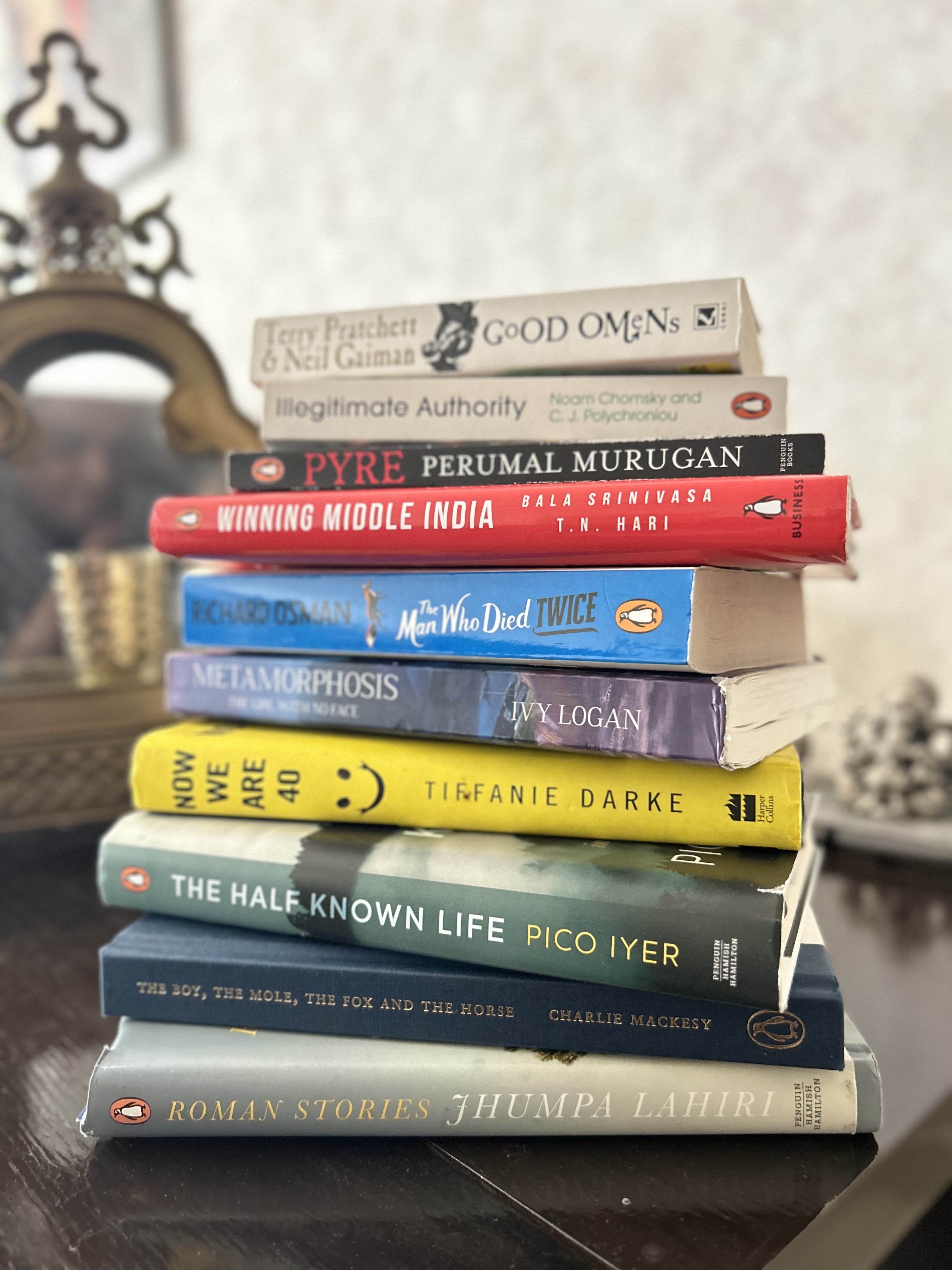
My Year 2023 in 16 Books


The year that was #2023 in 16 books. 


1. Jan: Winning Middle India, TN Hari, Bala Srinivasa- recommended by @deepikawarrier, this became the first book of the year, painting the picture of the new Middle India, based on insights from successful new gen start up companies that are creating products and services for this audience. 


2. Feb: If It Bleeds, Stephen King - Short stories in classic King style of haunting storytelling of unexpected events, including a sequel to the outstandingly terrifying novel “Outsider” (also an HBO series) a few years ago


3. Mar: The Man Who Died Twice, Richard Osman- the second book of what is now one of the most successful novel franchise in recent times, The Thursday Murder Club, though this one underwhelmed vs the first, but dying to read the third one. 


4. April: Now We Are 40, Tiffanie Drake: Thoroughly enjoyable narration of us, Gen X’ers life, culture, growing up (or not), influences and a validation of our legacy (if we do say so ourselves


5. April: The Half Known Life, Pico Iyer: A beautifully narrated travelogue of places around the world that give a semblance or illusion of paradise, across Iran, Australia, North Korea, Kashmir, Israel, Japan


6. The Boy, The Mole, The Fox and The Horse, Charlie Mackesy- a soulful, beautifully illustrated feel good book in a dark dark time. 


7.  The Immortals of Meluha, Amish - Did this as my first audiobook, and it worked better than my skepticism had suggested. Listening to stories can be as fun as reading them. And for this pop mythological fiction, it hit the spot. 


8. 1984, George Orwell - With intention to read atleast one classic every few months, picked this iconic novel, that was scaringly contemporary and absolutely genius in its almost prophetic vision of nation and politics. 


9. July: Good Omens, Terry Pratchett, Neil Gaiman- as hilariously whacky and mad hatter joyride as can be, since Douglas Adams. 


10. Aug: A Study in Scarlet, Arthur Conan Doyle, audio book again. Always wanted to read this classic and narrated by Stephen Fry, absolute joy to ‘listen’ to this book. 


11. Aug: Illegitimate Authority, Noam Chomsky- Fantastic conversations between brilliant political brains of our times, with penetrating insights on American politics, decisions, democracy and what it means for the US and the world. 


12. Sep: Pyre, Perumal Murugan - longlisted for the Booker, this English translation of the acclaimed author’s Tamil novel, was a real portrayal of the extreme intolerance of inter-caste marriage, but didn’t speak to me despite the poignant narrative in every page. 


13. Sep: The Inimitable Jeeves, P G Wodehouse- My all time favourite author, this time read it as an audio book, enjoying listening to the narration of the classic light hearted innocent and very British humour fix that we need from time to time. 


14. Oct: Metamorphosis, Ivy Logan- my author friend’s second book in the series of Breach Chronicles, with a classic young adult fantasy-romance fiction for the new reader. 


15. Nov: Ve Din, Nirmal Verma - decided to read a Hindi novel for the first time in my life to start honing my other language, which arguable is my first language. Not always easy, but got the hang of it and appreciate how different a language can make to the experience of a book, having assumed that English reading is the only option. An immersive story of few days of friends and love, in the life of an Indian student in university at Prague. 


16. Dec: Roman Stories, Jhumpa Lahiri - nothing like one of my favourite authors to end the year with. Another master stroke of short stories, all set in her current adopted city Rome. Indian origin English author writing in Italian and translating back to English! Go figure! In typical Lahiri style, each story a unique gem of portraying nuanced and authentic stories of people and their lives, each with their own pain and joy, their own freedom and prisons, with a recurring underlying theme of migrant lives in an increasingly intolerant world. 


Saturday, December 30, 2023

Animal, 2023 - Film Review

From the successful and acclaimed maker of Arjun Reddy and Kabir Singh, comes Sandeep Reddy Vanga’s next big expression of raw, intense, loud, full-on, alpha-male, testosteronama - Animal. And looking at the box office collection, it seems to be hitting the spot with the audience.


The story is about Vijay (Ranbir Kapoor), who grows up idolizing his father in the most extreme way, but without ever getting love or attention in return, due to his father Balbir Singh’s (Anil Kapoor) unavailability, both physically as well as emotionally. As a result, he grows up angry and yet always wanting to prove himself to his father, and to the world, that not only is he a man, but that he is the alpha among men, born to rule and lead. But no matter what he does, he can never win his father’s approval, whether he is protecting his sister from bullying by firing guns in college or marrying his childhood love, Gitanjali (Rashmika Mandanna), or for that matter, just basically being himself. The story then takes a turn, when his father is shot at (but recovers) by unknown assassins, which forces Vijay to return with his wife and kids from the US, to take charge of the situation, overhauling the entire setup in the way he feels right, and going on a revenge killing rampage against the enemy, following one bloodshed after another, till every last one of his enemy is brutally dead (well almost, watch out for part 2!). In the process, costing him almost his own life, his health, his marriage, his sanity, and his relationships. And after all this, does his father finally love him? Well…. 


Let’s get the most obvious thing on the table first. I totally get the need for a movie like this and what Vanga is all about. There is a place in cinema, just like in the world for creating spaces to allow for pure male expression. Just like there is place for creating spaces to allow for pure female expression. If we think of these spaces (and therefore content) as 2 intersecting Venn Diagram Circles, then there’s the part of the circles that are either only male or only female. And there’s that overlapping part in the middle that is common space for both male and female. And no gender should fault the other for enjoying or reveling in the expression of their gender as they feel….BUT, as long as it is not at the expense of the other gender and as long as it doesn’t foster a regressive path, that we’ve all been fighting so hard against. 

This film is squarely in the only male box. Just like Kabir Singh and Arjun Reddy. 


And just like Arjun Reddy/Kabir Singh, the collective male catharsis that the film delivers through every bloodshed scene, through the raw passion for one’s lover, through the blatant acceptance of the male body, and through the loud rejection of the quiet misogyny of our society, strikes a chord and is really what makes the movie worth watching.

But unlike Kabir Singh (read my review here…), Animal fails to deliver a complete experience.


The main problem with the film is while it seems to suggest that there is one central plot, there are actually too many stories being told at the same time, all of which don’t connect with each other too well, giving us a disjointed emotional experience. Plot 1 (the supposed central plot) is that a boy growing up without the love and attention of his alpha father, turns into a super-alpha male himself, with anger issues and destructive tendencies. Plot 2 is the business family feud that’s been running for generations, hidden from plain view that opens up like a mystery, throughout the movie till the end. Within Plot 2 itself, there are multiple layers - the estranged family in Punjab, the next generation of an angry family member in Scotland, someone being trained in Turkey, etc etc. And finally, there is Plot 3, the love story between Vijay and Gitanjali. Trying to tell all these stories at the same time, each having a very different rhythm and tone, makes us hop from one emotion to another, not fully allowing ourselves to feel any one of them. One minute, you’re feeling the passion that Vijay and Gitanjali are sharing, the next minute you’re reminded of this unloved boy’s story, and the next minute you’re immersed in the gang war family feud intense action sequence. And the worst part is that the writer is trying hard all the while, trying to connect all these stories to the supposed central plot of an unloved boy. As a result, while we enjoy some of the sequences, as a whole the movie just doesn’t come together as one piece, leaving us with fragments of action, dialogues, bloodlust, and anger. Especially after the intermission when it just meanders into unnecessary and new, complicated characters and stories. In fact, in the last hour of the movie, we’re introduced to a whole ecosystem of espionage and characters in Abrar, Aziz, and Zoya, among others, that suddenly become central to the storyline, which, I must say, is quite annoying to an audience that’s already given two and a half hours of their time and attention (more than what Vijay’s father gave him his entire life!)

By contrast, Kabir Singh was a single-minded love story and that’s why it worked beautifully. 


To be sure, Animal is NOT Kabir Singh, by a mile!


Also, we realize that Ranbir Kapoor is NOT Shahid Kapoor. While Ranbir puts up a good performance (much better than some of the hamming he’s been doing lately, and MUCH better than the disaster of Tu Jhooti Main Makkar), he is not able to pull off the different shades of the alpha intensity that Shahid portrayed in Kabir Singh. Ranbir’s acting is uni-dimensional. Showing alpha behavior equals loud and aggressive. Whereas, Shahid explored his alpha character also through his quietness, and through his solitude, through his tears, and even through his passing out, in addition to his loudness and aggressiveness.  


The other missed opportunity in this film is Anil Kapoor. Given that so much of the raison d'etre of the story was the absentee dad, we don’t get to see that side of the story explored at all. There’s a weak attempt in the last scene (and some mumbling between the mom and dad), but it just falls like a damp squib. If this was the central idea, how come it was not treated that way?


Perhaps the challenge is Vanga making his first original film in Hindi. Arjun Reddy was conceived, written, and made in Telugu end to end. And then Kabir Singh was a copy-paste in Hindi. Perhaps conceiving and writing for Hindi cinema is what made the storytelling confusing and less impactful. We’ve seen this before as well, even with the legendary filmmaker Mani Ratnam, where his original Tamil masterpieces dubbed (like Roja or Bombay) or remade in Hindi (like Yuva or Saathiya) were brilliant pieces of work, but those originally conceived in Hindi (like Dil Se or Raavan) were less so.


Whatever the reason Arjun Reddy/Kabir Singh were fab films. Animal is not!

But, what does stay with us as we walk out of the theatres, is the very loud and very clear message. 

Dads, please love your sons!

Else the whole world is going to pay for it!

Thursday, December 28, 2023

Dunki 2023, Film Review

What happens when a great story teller, known for telling deeply personal stories with a commentary on social issues, in a light hearted emotional way, attempts to fall in line with the prevailing winning majoritarian formula of telling nationalist stories? May be from here on, we can call this “Pulling a Dunki”. 

The story, mostly told in a flashback, revolves around Manu (Taapsee Pannu), Buggu (Vikram Kochar), and Balli (Anil Grover), each of who, desperately want to move to London, from the village Laltu, in Punjab, set in the India of the 1990s. Each with their own individual reasons for a better life for their families. When the official route of passing IELTs and getting visas fails them, leading to a dire tragedy of their close friend, our hero, Hardy (aka SRK) vows to get his friends to London, by hook or by crook. And so they embark on the brutally infamous illegal migration route, known as Dunki, crossing borders of Pakistan, Afghanistan, Iran, Turkey and finally UK, suffering all through at the hands of violence, hunger, death, drowning, disease, and mental torture. After all this, the abject poverty and helplessness of the illegal immigrant life in UK further adds to the grief, that never fully gets better even after 25 years of living and earning in pounds, and lifting their families out of poverty back home. Was it all really worth it? They wonder and start their journey back home, only to meet their next adventure of illegally migrating back, again only made possible by our dare devil travel partner, Hardy. And ending finally a kind of happy ending, for most of the characters anyway. 


Now, to be fair, migration is a real and a big issue in the world today. It’s so big that across most of the Western world, the definition of whether you’re a liberal or not is being defined by your stance on immigration into your country. And it’s true that the biggest victims of restrictive immigration policies are the poor, and therefore the consequence of worsening inequality in an already unequal world. And finally, for sure, this message needs to be given to many in India who, not knowing better, aspire to an imagined life abroad that only brings them disappointment and misery. Whereas a choice to stay back in their own motherland might have just worked out better in the long term. Especially, in the context of what we are told in the media everyday, Indiyaah Indiyaah! Clap clap clap. 


And so, to take up making a movie on this issue, is, itself quite ambitious and for that we complement you, Raju Hirani and Abhijat Joshi. This is definitely much harder than championing the cause of everyday love and humanity in our lives (Munnabhai) or commenting on our flawed education system (3 Idiots) or showing a mirror to our intolerant superstitions, biases and religious bigotry (PK).


But, this is not what your core competence (as we would say in business language) is, Mr Hirani. Your craft is in building characters and making the audience form an intimate relationship with them. Munnabhai was the leader we never had. Circuit was the loveable side-kick with ultimate jugaad that we could depend on. Rancho was the friend that made you a better and happier person. And this was true  of the entire cast. Whether it was Qureshi, Rastogi, Virus,  or any of the others. Because of this, we felt what they felt in the film, and experienced the film in the first person. Unfortunately, Dunki doesn’t help us form any relationship with any of the characters. They all feel distant, unconvincing, and almost caricaturish. As a result, we are watching the film in the third person, at best laughing at the jokes or sympathising with some characters and scenes, but mostly watching the hours pass by.


The second reason is that Raju Hirani's usual brilliance comes from the fact that he gets people and society, and more importantly, the deep interconnectedness of these two units. And the flawed humanity at the centre of it, that creates room for both laughter and tragedy at the same time. That’s why it connects with us. Because it’s the story of our everyday lives. If “Roz Marra ki zindagi” became a social media influencer, that would be a Hirani movie. Dunki, unfortunately, is not about the “micro” units of people and society,  but about the “macro” units of nation and politics. And therefore Hirani trying to tell an emotional people-story here makes it feel shallow, inauthentic and laborious. This genre is best left to either the Anil Sharma’s (aka Gadar) or the Meghna Gulzar’s (aka Raaz/Sam Bahadur) of the world, depending on your preference. 


The third reason the film fails is because of the quintessential missing narrative style of a good Hirani film. His style is that of satire or “Vyangya” as we describe it more aptly in Hindi. Take Munnabhai 1 and 2, or 3 idiots, or PK. Each of them uses satire as a powerful tool to make us feel, reflect and laugh all at the same time. Much like what a stand up comedian does. Take the satire out, and all you have is a bunch of trite or heard-before jokes, just made louder with a generous dose of Punjabi-ness. Like “I want to go to Lava-tory”! Ugh! Dunki, unfortunately, is that. 


And finally, if disappointing writing and story telling wasn’t bad enough, the actors don’t manage to compensate for any part of this loss either. SRK, after a what seemed like a comeback with Pathaan and Jawaan (read my reviews of the two earlier in the year), misses the ham-trick (I mean hat-trick!) reminding us of everything we had tried to forget this last decade or so. Tapsee Pannu, is herself like in every movie, only worse, with a fake old skin and a grey wig. The other two support characters, Buggu and Balli and even Boman Irani, are instantly forgettable. And Vicky Kaushal, in guest appearance gives a brief glimmer of hope, that quickly fades away. 


All in all, because we love your movies so much Raju Hirani, we’re happy for you that you tried a new topic, a new narrative and a new story telling to explore your creative potential and possibilities. But, please could you go back to what you do best. We could do with a good Hirani fix in our grim world today. That’s what we were hoping to get with this one, as we ended this year and looked forward to a new year. And that’s what we didn’t get. 

And that’s why we are sooooooo disappointed.

Here’s hoping for the next one!

Saturday, December 23, 2023

The Archies, Netflix, Film Review, Dec 2023

What message do we want to give our adolescents that are struggling to make sense of the world they are seeing around them and their own future within it? 


As I see it we have two choices. 


One, we tell them that the world is fucked and it’s only going to get worse, so better grow up fast, don’t believe blindly in anything you hear, listen to all the voices around you, and fight for what’s right and for the world you want to inherit. Let’s call this the “Hunger Games” school of thought. 


Or, two, we tell them that the grown up world is over-rated and that no one has the answers and that what matters is them and their faith and their imagination; and that we believe in them to find their own answers to craft the world of the future in the way they see right and beautiful. I call this the “Robin Williams” school of thought. 


I’m not going to discuss for, or against any of the two, because we all know we ourselves move between one or the other all the time. But suffice it to say #TheArchies on Netflix sits squarely in the second category. 


Inspired by the iconic Archie’s comic book, this Zoya Akhtar’s musical take is a light, easy breezy telling of high schoolers and their sweet-nothing everyday lives filled with hormones, romance, dreams, music, future-gazing, heart breaks, and partying. Living in the fictional hill town of Riverdale, (an Anglo-Indian settlement) and in the afterglow of post independence India of the 60s (before the wars and emergency), the story starts with Veronica Lodge (Suhana Khan) who returns from London with her parents. Mr. And Mrs. Lodge want to transform the quiet green town into a commercial hub, breaking down among other things the soul-centre of the town, Green Park. Archie Andrews (Agastya Nanda), true to his nature, romances both Veronica and Betty Cooper (Khushi Kapoor), with aspirations of getting out of Riverdale, to London for college. Along with the rest of the Archie’s cast of Jughead, Reggie Dilton Doiley, Ethel, Midge, and Moose, these teenagers go through their trials and tribulations, while in the background the town begins to change, giving into the forces of brutal capitalism. As things come to a head and the beloved Green Park is in danger of being razed to the ground, and the adults succumb to money and power, it’s only the youth brigade of the town that comes to the fore to save the day, preserving what’s good and pure in the world, making their way towards building their future. 


One could find many faults in the film. It feels a little too American High School Musical. It feels too simplistic and naive a story for a highly complex world we live in. It is bubblegum and popcorn and more pink than even Barbie was.  The actors and their performances are average at best. (With the exception of perhaps Reggie, played impactfully by Vedang Raina).  And most of all it speaks and perhaps celebrates the sensibility of a privileged class in society, that the same film maker lamented against in Gully Boy.  


But, the film also talks about personal issues that preoccupy the youth today. It celebrates the idea of choosing your home and country and creating opportunities here rather than going abroad. It raises the conversation on capitalism and consumption and how that’s messing our planet. It encourages the young to think and talk about politics (at a critical moment in time in our country). And it talks about identity formation (including gender) and finding the answers within. The moment in the room when Reggie acknowledges Ditlon’s identity is beautifully and empathetically done. It’s the conversation Mike should have had with Will in Stranger Things Season 4 (remember that heart breaking moment!).


But most of all, why the film should be watched is because at the heart of it, it’s about celebrating the agency of the youth. What could be more important and critical in our world than that. To make the future generation believe that they can change the future. They don’t have to just 'inherit' it. At a time when loneliness and mental health challenges of our young ones are at their worst ever, how can we not promote anything and everything that helps them believe that things can get better, that THEY can make it better. As a society and as adults, have we become so bitter that the only thing we see is in the film is star kids, and nepotism! Let’s give the kids a break. More importantly, let’s give them a chance. A chance to change the world for all of us. Without filling them with our fears and cynicism and our social media views. As the title song Sunoh says “You say I’m young and I’ve got nowhere to be, I say there’s so much I can do”


Or at the very least, let us enjoy a few hours of suspension of our reality and be naively optimistic.  Nothing wrong with a little dose of that from time to time. Heck, it's New Year time! Remember the film is graded 13+. If we’ve enjoyed and applauded so many Disney movies with a sense of joyous optimism, why can’t we for this one?

It may not be the Archie’s us oldies grew up with, but it’s the Archie’s that the current generation can enjoy perfectly well, if we let them. 


In the end, it’s a short, young, fun, easy and enjoyable musical film, with a great soundtrack by Ankur Tewari, The Islanders, Dot and Shankar Ehsaan Loy. What more can we ask for from a film? Stop over-thinking it and just go and watch it!

Saturday, October 28, 2023

Metamorphosis by Ivy Logan - Book Review

This one’s for my friend, author known as Ivy Logan, writer of young adult fiction straddling fantasy, romance, and adventure, with a proud four books to her name already. 


This is the second book in the series, known as the Breach Chronicles, that straddles the world of humans on planet Earth and the world of sorcerers and immortal beings in interstellar planets like Htrae (earth spelled backward, so perhaps a metaphor for humanity starting from the wrong side!). 


This second book tells the story of Amelia, a descendant of the sorcerer's family. Living as a human, unaware of her magic, growing up tortured and persecuted by her ruthless uncle Liam, the cruel dictator of the South American nation Peradora. The story revolves around how as she grows through her troubled childhood, and teenage years, after her parents' murders, finds herself and her purpose in fighting for the cause of the citizens of her country, who have been victimized and subjugated for years by Liam and his political compatriots. Finding and losing people she loves throughout her journey, she finds her partners in crime, toward eventually winning against the bad guy. Or does she?


The book has an easy storytelling style, that fits perfectly for a new teen or young adult reader, who is discovering the notion of immersing in a book and a world created by the imagination of the author. For new readers, it helps in making them access the idea of reading at an earlier age, without feeling bored or intimidated. 


Written for the city-living-privileged-teenagers, the storytelling reflects perfectly the self-indulgent and emotionally turmoil-ridden world that they inhabit. Both when Amelia is a victim and also when she is the hero. The emotions she goes through would be relatable to every adolescent we know. Self-doubt, attraction, loyalty, friendship, loneliness, aspiration to be something more, idealism, desire to change the world, doing what’s right, struggling, winning, and quite often losing. Yet constantly driven by the promise of a tomorrow that will be far better than today. 


The narrative style of using the first person throughout the book is refreshing. Telling the story from the perspective of different characters is a great way to make the reader feel the different characters and therefore feel the story from different views. However, the author misses this beautiful opportunity to tell different stories. As a result, whether it’s Noah (Amelia’s love interest) or Adrian (Amelia’s first crush) or Liam (the bad guy) telling the story, the emotions and the inner world of the narrator feel no different. And so we experience the whole story in the same tone and manner, which is that of the author, or perhaps of Amelia, leaving the reader a little distant from everything that’s happening. 


The book also misses the opportunity to surprise the reader with new stories. For a generation that’s flushed with content on OTT platforms and social media, a lot of the situations feel like we’ve seen them before. Humans with unexplored magic potential, shape-shifters into beasts, a mass rebellion in the mines against the evil ruler, jealousy linked to romance, et al.  All of it leaves you craving the possibility of having explored perhaps a new emotion, a new plot, or a new character. We’ve seen Amelia before, the poor-little-rich- victim underdog that saves the world. We’ve known Noah, the strong and silent lover with demons inside that he fights constantly and despite himself falls in love, forever protective of her. We’ve witnessed Adrian, the misunderstood friend-zoned first crush that has gone to hell and back, and will always be the support that Amelia needs.


However, what works in the book is that we’ve never seen all of this together before, and told in a nicely interwoven simple way, with no pretenses. That comes as a breath of fresh air and makes for a light and uncomplicated read for our very complicated times. This is not a book that’s trying to make a point. This is a book that only wants you to go with the flow and enjoy  being an adolescent (I know that’s oxymoronic for adolescents, but wait till you get to my age!) And for this simple vision of the book, we cheer on Ivy Logan to write more without feeling the pressure to grow up.  For, as we know, being a grown-up is so overrated anyway. 

Monday, October 2, 2023

Jawaan, 2023, Film Review

 ****spoilers alert*****

What is the purpose of big cinema? Is it not to help us dream of a world that is better than today? Is it not to give us a collective moment of catharsis as we beat the injustice in the world and its perpetrators? Is it not to feel that we are all a small part of a large movement? Is it not to laugh at all the imperfections we live with, in ourselves and in our society? Is it not to cry at the pain and suffering we see in our lives and all around us? Is it not to get entertained despite our intellectual pretences? 


Jawaan, then, is as on-the-spot big cinema as it gets. 


After the first Bollywood blockbuster of the year in January, with Pathaan, SRK proves he is King Khan, once again, with the next biggest grosser of the year. It seems like the older he gets, the more jawaan his impact.


The story revolves around the emergence of a masked vigilante super hero, Vikram Rathore, who stages heists and attacks in public spaces, with the sole purpose of avenging wrong doings by people in power against ordinary citizens. SRK, as Azaad, the progressive jailer of a women’s prison, is of course this saviour, who with his team of 6 women (wrongly accused and imprisoned) plans and masterfully executes each of these missions, winning public adulation, even as the good cop Narmada Rai (the gorgeous Nayanthara) tries to unsuccessfully catch him every time. The plot thickens, as the connections of Azaad’s quest for justice intertwines with his own personal backstory of injustice done to his father (the Indian soldier Vikram Rathore, also played by SRK and his mother Aishwarya, played by Deepika Padukone), that have led to their subsequent brutal deaths. As, the story further complicates with Narmada falling in love and marrying Azaad, and the re-emergence of senior SRK (with memory loss!), and the bad guys (Kalee played by Vijay Sethupathi) getting even, it all leads to a final (predictable) climax of good winning over evil, and a satisfactory take away message for all of us.


SRK and Tamil director Atlee, hit a master-stroke in getting the right balance of evoking emotions of social issues from recent memory that many in the audience would be feeling and seething about. Farmer suicides, Big corporate frauds at the expense of the public, capital cronyism, and in general the overall rampant corruption in public goods and services like the medical system and even military purchases. The film further cleverly ties the last issue deeply with our collective and nationalistic solidarity with Indian soldiers (“jawaan”) to get the right emotions flowing, as we continue cheer for the film. And finally, landing the big message that underlines the very being of democracy (serendipitously timed ahead of the national elections next year). Of who we vote for and why.


This mixed with the some really good action, typical Bollywood one-liners and a whole lot of SRK in double role, both as an old man and as the jawan-man, makes for a full-on high octane entertainer, with not a single dull moment.


What is really interesting to witness and perhaps why the film is seeing the success it is, is an organic merging of Hindi and South Indian cinema making. The film would make a whole lot of sense even if it was made in Tamil or Telugu or Kannada. We’ve seen lots of South Indian cinema being popular across the country now. And similarly a lot of Hindi cinema going pan India. But Jawaan is unique because it is not one or the other, but both in its very being. Shah Rukh is both SRK and Rajnikanth at the same time. The action, with its heightened blood and gore is both Bollywood and Tollywood together. The drama with all its exaggerated tone is both North and South. The messaging, with a mild anti-corporate, a mild left’ish stance amidst a largely well-to-do urban and well-dressed characters, again speaks of both worlds together. In creating this potential mixed breed of story-telling, Atlee has definitely invented something new. That is hitting the spot, and actually multiple spots in our minds and hearts.


All in all, a thoroughly entertaining film, as we see SRK getting older and perhaps a little bit wiser, moving on decisively from his erstwhile romantic hero mantle (passing it on to the Ranveers and the Karthiks of the world) and realising his next calling of being the action saviour for a world that needs one. 


To save the world. To save us. To save Bollywood. 

Amen!

Saturday, September 2, 2023

Made in Heaven Season 2, Amazon Prime, Review

Second seasons of successful shows can always be tricky, but not that uncommon especially in OTT platforms. Plenty of shows continue successfully well into multiple seasons. Family Man, Succession, Stranger Things, Money Heist, etc etc. Each of these shows builds on the foundation laid in the first season and then milks it, but all the while staying quite close to the central idea of their first seasons. 


However, very few shows actually get better with time and create new stories and narratives that weren’t there in the first season. That takes both bravery and imagination and equally creative cleverness to balance the familiarity of Season 1 (which is important for people to see it in the first place), with telling new stories.


Made in Heaven Season 2 does just that and that too really well. Using the main stage of rich people's weddings with dysfunctional and regressive realities, set in Delhi (obviously, eye-roll), seen through the lens of equally dysfunctional but progressive wedding planners, is quite a brilliant formula, that hits the sweet spot of showing a mirror to our society, yet evoking empathetic emotions to the multiple and varied characters in the show.  Every episode with new characters deals with one dominant societal issue of our time- gay weddings, wife-beating, casteism, ageism, materialism, beauty, etc etc. While the continuing central characters build the ongoing themes of inclusion, gender equality, non-binary sexuality, women empowerment, and most importantly of course seeking and finding love.


To be honest, I didn’t really care much for Season 1. Even though the vision of the makers was clear to see and super relatable and relevant, the plot was a bit too intellectual, the stories a bit too pretentious, the characters a bit too caricaturish, and the emotions a bit too distant. As a result, I remember feeling intrigued, interested, and definitely supportive of the cause, but also feeling a little cold, superficial, and very ‘south Delhi’ and ‘Angrezi-Medium’. In fact, interestingly, it is the continuity factors from Season 1, that continue to detract even in Season 2. Tara, despite being a beautifully flawed character with multiple shades of grey, leaves us at best intellectually interested, but still emotionally distant. Karan, again a beautifully complex and layered character with so many emotions, leaves us intellectually empathetic, but emotionally blasé. 


But what Zoya and Reema have really cracked in Season 2, is the many new characters in the central plot and those in the different individual stories in each episode. Trinetra Haldar Gummaraju as Meher, the trans, production manager of Made In Heaven is brilliant, as we feel her emotions through her dialogue, her baritone, her expressions, and her authenticity. Mona Singh, as Bulbul Jauhari, the Hindi-medium foil to the Angrezi set up is an absolute delight to watch with her quiet yet extremely impactful feminist actions, not least of all rescuing her son from falling prey to misogynistic patriarchial upbringing. Vijay Raaz, as the investor and more importantly supportive husband of Bulbul, is excellent in his understated role throughout the series. Other new characters like Akshay Jaiswal (Karan’s new love interest) is a likable-easy breath of fresh air to Karan’s intense-activist-self destructive gay existence, Gauri Khanna (Adil-Jim Sarbh-Khanna’s unknown half-sister revealed after his father's death) is a shot of real humanity to Adil’s fake rich life; Raghav, Tara’s new love interest as the middle-class “Gurgaon EMI” type chef-restaurateur that brings out the nice side to Tara is a pleasant break from the otherwise high life vistas of the show. 


And then there are the new characters with new stories and deep human sentiments that again strike a chord with the audience.  Be it Radhika Apte as the Dalit bride fighting for equality in a casteist society, Diya Mirza almost giving up on life against a patriarchal tradition of polygamy, or Sarah Jane Dias not succumbing to marriage as the only option, or Neelam Kothare deciding to finally give up on her chauvinist husband and son for her lover. Or even Mrunal Thakur, heartbreakingly giving in to marrying an abusive lover. Each of them has us rooting for them, loving them, crying for them, and cheering for them, as they find their own journeys through the dysfunctional society we live in, finding their karma and love in one form or another.


But most of all what Zoya and Reema have successfully accomplished in Season 2, which was abundantly missing in Season 1, is its positive story-telling that leaves us with a sense of affirmation. Season 1 was dystopian, but Season 2 shows us that the opposite of dystopia doesn’t have to be utopia, it can be “lets figure it out together with a spring in our step and joy in our hearts”. If Season 1 left us in despair, Season 2 leaves us with hope. If Season 1 showed us the mirror, Season 2 opens the curtain just a little bit to let the morning light in. If Season 1 celebrated cynicism, Season 2 propagates agency, agency to do something about it, god dammit. If Season 1 broke our hearts, Season 2 opens our hearts to seeing possibilities. 


Not all is well with the world. We know that. But not all is wrong either. The choice is always ours. It always was, and always be. Now that’s a nice feeling to walk out with, at the end of the season. Here’s looking forward to Season 3, Zoya and Reema. More power to you.