Monday, October 2, 2023

Jawaan, 2023, Film Review

 ****spoilers alert*****

What is the purpose of big cinema? Is it not to help us dream of a world that is better than today? Is it not to give us a collective moment of catharsis as we beat the injustice in the world and its perpetrators? Is it not to feel that we are all a small part of a large movement? Is it not to laugh at all the imperfections we live with, in ourselves and in our society? Is it not to cry at the pain and suffering we see in our lives and all around us? Is it not to get entertained despite our intellectual pretences? 


Jawaan, then, is as on-the-spot big cinema as it gets. 


After the first Bollywood blockbuster of the year in January, with Pathaan, SRK proves he is King Khan, once again, with the next biggest grosser of the year. It seems like the older he gets, the more jawaan his impact.


The story revolves around the emergence of a masked vigilante super hero, Vikram Rathore, who stages heists and attacks in public spaces, with the sole purpose of avenging wrong doings by people in power against ordinary citizens. SRK, as Azaad, the progressive jailer of a women’s prison, is of course this saviour, who with his team of 6 women (wrongly accused and imprisoned) plans and masterfully executes each of these missions, winning public adulation, even as the good cop Narmada Rai (the gorgeous Nayanthara) tries to unsuccessfully catch him every time. The plot thickens, as the connections of Azaad’s quest for justice intertwines with his own personal backstory of injustice done to his father (the Indian soldier Vikram Rathore, also played by SRK and his mother Aishwarya, played by Deepika Padukone), that have led to their subsequent brutal deaths. As, the story further complicates with Narmada falling in love and marrying Azaad, and the re-emergence of senior SRK (with memory loss!), and the bad guys (Kalee played by Vijay Sethupathi) getting even, it all leads to a final (predictable) climax of good winning over evil, and a satisfactory take away message for all of us.


SRK and Tamil director Atlee, hit a master-stroke in getting the right balance of evoking emotions of social issues from recent memory that many in the audience would be feeling and seething about. Farmer suicides, Big corporate frauds at the expense of the public, capital cronyism, and in general the overall rampant corruption in public goods and services like the medical system and even military purchases. The film further cleverly ties the last issue deeply with our collective and nationalistic solidarity with Indian soldiers (“jawaan”) to get the right emotions flowing, as we continue cheer for the film. And finally, landing the big message that underlines the very being of democracy (serendipitously timed ahead of the national elections next year). Of who we vote for and why.


This mixed with the some really good action, typical Bollywood one-liners and a whole lot of SRK in double role, both as an old man and as the jawan-man, makes for a full-on high octane entertainer, with not a single dull moment.


What is really interesting to witness and perhaps why the film is seeing the success it is, is an organic merging of Hindi and South Indian cinema making. The film would make a whole lot of sense even if it was made in Tamil or Telugu or Kannada. We’ve seen lots of South Indian cinema being popular across the country now. And similarly a lot of Hindi cinema going pan India. But Jawaan is unique because it is not one or the other, but both in its very being. Shah Rukh is both SRK and Rajnikanth at the same time. The action, with its heightened blood and gore is both Bollywood and Tollywood together. The drama with all its exaggerated tone is both North and South. The messaging, with a mild anti-corporate, a mild left’ish stance amidst a largely well-to-do urban and well-dressed characters, again speaks of both worlds together. In creating this potential mixed breed of story-telling, Atlee has definitely invented something new. That is hitting the spot, and actually multiple spots in our minds and hearts.


All in all, a thoroughly entertaining film, as we see SRK getting older and perhaps a little bit wiser, moving on decisively from his erstwhile romantic hero mantle (passing it on to the Ranveers and the Karthiks of the world) and realising his next calling of being the action saviour for a world that needs one. 


To save the world. To save us. To save Bollywood. 

Amen!

Saturday, September 2, 2023

Made in Heaven Season 2, Amazon Prime, Review

Second seasons of successful shows can always be tricky, but not that uncommon especially in OTT platforms. Plenty of shows continue successfully well into multiple seasons. Family Man, Succession, Stranger Things, Money Heist, etc etc. Each of these shows builds on the foundation laid in the first season and then milks it, but all the while staying quite close to the central idea of their first seasons. 


However, very few shows actually get better with time and create new stories and narratives that weren’t there in the first season. That takes both bravery and imagination and equally creative cleverness to balance the familiarity of Season 1 (which is important for people to see it in the first place), with telling new stories.


Made in Heaven Season 2 does just that and that too really well. Using the main stage of rich people's weddings with dysfunctional and regressive realities, set in Delhi (obviously, eye-roll), seen through the lens of equally dysfunctional but progressive wedding planners, is quite a brilliant formula, that hits the sweet spot of showing a mirror to our society, yet evoking empathetic emotions to the multiple and varied characters in the show.  Every episode with new characters deals with one dominant societal issue of our time- gay weddings, wife-beating, casteism, ageism, materialism, beauty, etc etc. While the continuing central characters build the ongoing themes of inclusion, gender equality, non-binary sexuality, women empowerment, and most importantly of course seeking and finding love.


To be honest, I didn’t really care much for Season 1. Even though the vision of the makers was clear to see and super relatable and relevant, the plot was a bit too intellectual, the stories a bit too pretentious, the characters a bit too caricaturish, and the emotions a bit too distant. As a result, I remember feeling intrigued, interested, and definitely supportive of the cause, but also feeling a little cold, superficial, and very ‘south Delhi’ and ‘Angrezi-Medium’. In fact, interestingly, it is the continuity factors from Season 1, that continue to detract even in Season 2. Tara, despite being a beautifully flawed character with multiple shades of grey, leaves us at best intellectually interested, but still emotionally distant. Karan, again a beautifully complex and layered character with so many emotions, leaves us intellectually empathetic, but emotionally blasé. 


But what Zoya and Reema have really cracked in Season 2, is the many new characters in the central plot and those in the different individual stories in each episode. Trinetra Haldar Gummaraju as Meher, the trans, production manager of Made In Heaven is brilliant, as we feel her emotions through her dialogue, her baritone, her expressions, and her authenticity. Mona Singh, as Bulbul Jauhari, the Hindi-medium foil to the Angrezi set up is an absolute delight to watch with her quiet yet extremely impactful feminist actions, not least of all rescuing her son from falling prey to misogynistic patriarchial upbringing. Vijay Raaz, as the investor and more importantly supportive husband of Bulbul, is excellent in his understated role throughout the series. Other new characters like Akshay Jaiswal (Karan’s new love interest) is a likable-easy breath of fresh air to Karan’s intense-activist-self destructive gay existence, Gauri Khanna (Adil-Jim Sarbh-Khanna’s unknown half-sister revealed after his father's death) is a shot of real humanity to Adil’s fake rich life; Raghav, Tara’s new love interest as the middle-class “Gurgaon EMI” type chef-restaurateur that brings out the nice side to Tara is a pleasant break from the otherwise high life vistas of the show. 


And then there are the new characters with new stories and deep human sentiments that again strike a chord with the audience.  Be it Radhika Apte as the Dalit bride fighting for equality in a casteist society, Diya Mirza almost giving up on life against a patriarchal tradition of polygamy, or Sarah Jane Dias not succumbing to marriage as the only option, or Neelam Kothare deciding to finally give up on her chauvinist husband and son for her lover. Or even Mrunal Thakur, heartbreakingly giving in to marrying an abusive lover. Each of them has us rooting for them, loving them, crying for them, and cheering for them, as they find their own journeys through the dysfunctional society we live in, finding their karma and love in one form or another.


But most of all what Zoya and Reema have successfully accomplished in Season 2, which was abundantly missing in Season 1, is its positive story-telling that leaves us with a sense of affirmation. Season 1 was dystopian, but Season 2 shows us that the opposite of dystopia doesn’t have to be utopia, it can be “lets figure it out together with a spring in our step and joy in our hearts”. If Season 1 left us in despair, Season 2 leaves us with hope. If Season 1 showed us the mirror, Season 2 opens the curtain just a little bit to let the morning light in. If Season 1 celebrated cynicism, Season 2 propagates agency, agency to do something about it, god dammit. If Season 1 broke our hearts, Season 2 opens our hearts to seeing possibilities. 


Not all is well with the world. We know that. But not all is wrong either. The choice is always ours. It always was, and always be. Now that’s a nice feeling to walk out with, at the end of the season. Here’s looking forward to Season 3, Zoya and Reema. More power to you.

Saturday, August 12, 2023

Rocky Aur Rani Ki Prem Kahaani, 2023, Film Review

It’s the season of feminism and progressive stories. If Barbie was Hollywood’s way of provoking us against our regressive social structure, Rocky Aur Rani is Bollywood’s ode to the same. And true to each style of storytelling, if Barbie takes one issue (unequal gender balance of society), Rocky Aur Rani, attempts to take on ALL possible regressive mores of our society. From women empowerment to infidelity in loveless marriages to age discrimination, to class-ism, to intellectual discrimination, to patriarchy, and of course, the challenge of finding love by the youth in today’s increasingly complex world. 

The story revolves around Rocky (Ranveer Singh) and Rani (Alia Bhatt) who have a chance meeting when Rocky, looking for his dadaji’s (Dharmender) long lost love Jamini Chatterjee (Shabana Azmi), meets Rani (who happens to be Jamini’s granddaughter). In an attempt to cure Dadaji’s dementia, as they try to get the two septuagenarians together, the inevitable happens and Rocky and Rani fall in love with each other. The trouble? Their families and backgrounds are as far apart as possible. Rani’s family is an upper-middle-class intellectual professional Bengali family in CR Park, Delhi, immersed in Tagore and the arts, music, and all other cliches you can think of when you think of the Bhadralok. Rocky’s family, is a super rich patriarchal Punjabi business family from old Delhi, with all its cliches you can think of. Knowing that their different backgrounds could create havoc in their relationship in the future, they decide to do a live-in with each other’s family for 3 months, with the aim to resolve this. What follows is a series of emotional and humorous incidents, towards the final happy ending that we all know is coming.


In many ways, the success of this film is pleasantly surprising. Because in 2023, if this old-school love story from my generation is working again, maybe the cynicism on love and romance in the movie-making of the last decade is beginning to wane. Rocky aur Rani is a classic Gen X love story from the 90s. Boy meets Girl. Boy and Girl fall in love. Boy and Girl have love ke dushman (usually the family). Boy and Girl get together to fight against the dushman. And love conquers all. Boy and Girl live happily ever after. This simple story, coupled with lots of retro references to old movies, and songs, is what makes the film eminently watchable and fun.


And what really makes the movie come alive, is the two main leads and the chemistry they share. Ranveer and Alia are a joy to watch both by themselves and when they are together. Ranveer, even with his stereotypical character, plays the part so adorably that you can’t help loving him, despite his very obvious in-your-face flaws, much like Rani herself. Rani, again, despite being a cliched intellectual Bengali character, is so vibrant and impactful, that you can’t help agreeing with the transformation she is bringing in Rocky and his regressive patriarchal family. And when together, their love for each other even though they are cringe-ly different (She tests his levels of knowledge by asking him where is West Bengal!!!), is so irrepressible that you can’t help cheering for them as they conquer their own limitations and then use that to conquer the family barriers to their love story. And to top this off, is the heartwarming presence of  Dharmender and some glowing moments by Shabana Azmi, that add just the right verve to the movie.


While there were a lot of hackneyed lessons and messages throughout the story, championing progressiveness and inclusiveness, some of the new areas like the hypocrisy of the supposedly progressive intellectual society being un-inclusive to the less educated business Punjabi society, bring some freshness to the messaging. 


But perhaps, the big miss in the film is not building the richness of all the other characters, played by some talented actors. All the others, including Jaya Bachchan evoking her inner Amitabh Bachchan’s stubborn patriarch from K3G, are less impactful and a bit too caricaturish, leaving us disappointedly distant from their side of the story. The character of Dhanalakshmi (Jaya)  having built the business empire singlehandedly as a woman, had an opportunity to bring another feminist angle to the story, instead of restricting her to a narrow saas-bahu narrative. Similar opportunities are lost in Rocky’s mother and sister, who are just shown as uni-dimensional victims of a patriarchal home, or Rocky’s father, a uni-dimensional angry alpha man. Or Rani’s parents, playing uni-dimensional arty-intellectual-British-hangover Bengali parents. Alas, K-Jo!


The other big thing we miss from a classic Bollywood box office entertainer is a good soundtrack. The music is really not good. Apart from the very average Jhumka song and the retro songs re-sings, the lack of good songs to get up and cheer for, is felt profoundly in a love story movie. And is something that will reduce the life of the movie, after we walk out of the theatres. What a loss! 


But, at the end of the day, what we get to see is a classic Bollywood Karan Johar fare that’s entertaining, enjoyable, and full paisa-vasool. It’s good old, loud, over-the-top, jhinchak, colorful, vibrant, full-on Hindi cinema that we last saw in Pathaan in Jan, and had almost lost hope that there will be more of in the year. Rocky aur Rani delivers to our fundamental need for the box office fix. Toh zyaada sochne ka nahi. Dekho, hason, thoda sa life lesson le lo, khaao, piyo aur khisko. 

Saturday, August 5, 2023

Barbie, 2023, Film Review

Touted as the most important feminist movie of the year, acclaimed director Greta Gerwig (of Little Women fame), and Mattel’s marketing genius, brings to ‘real-reel’ life for the first time the much loved and controversial iconic toy, Barbie. 

The film revolves around, well, Barbie, played by the gorgeous and talented Margot Robbie, whose perfect world starts falling apart when thoughts of death and an identity crisis forces her to journey to the real world. Where she realizes that, unlike what the Barbie world felt they had done for humankind, the real world is still ruled by toxic masculinity and patriarchy, and that the whole ‘women-rule-the-world’ was just a clever ruse by men to continue to stay in power. Infected by the same, Ken (again a good performance by Ryan Gosling) brings patriarchy back to Barbie world, which crumbles easily and completely. This triggers the rest of the story where Barbie, helped by real-world mom Gloria (American Ferrera, of TV series Super Store fame) and her daughter Sasha (played by Ariana Greenblatt, seen in Netflix’s Awake) join hands with the other Barbies (led by weird Barbie, Kate McKinnon), and hatch a plan to use male ego and vain power-hunger against them, taking back control of the world, restoring ‘perfection’ once again. 


The film felt a little bit like The Matrix, if given a choice of the red pill and the blue pill by Morpheus, Trinity would have stepped forward and chosen the hidden option of the pink pill, giving Neo no option but to tag along with her into a confusing and supposedly enlightening trip across wonderland. Like The Matrix, the film clearly argues against taking the blue pill and going back to living comfortably in our gender-imbalanced world, not acknowledging the troubled reality of our social and political structure. That, we wholeheartedly support and cheer for. BUT, unlike The Matrix, the film doesn’t promote taking the red pill either, which would have forced us to “feel” the grossly unequal and toxic world through an emotional ride into what we see around us, making us take a stand and putting up a fight to change the world for the better. INSTEAD, the film pushes the pink pill, which settles at a moral science textbook lesson for two hours, given by the various characters in the film. As a result, we walk out of the theatre, feeling lectured to, rather than being empathetically immersed in what could have been an emotional story of a genius idea - using arguably one of the most controversial-feminist icons to tell a feminist story.


Not to take away from the fact that there are some powerful moments in the film. The opening scene with little girls being saved by Barbie, from their house-house games sets a powerful ambition for the movie. The scenes with the brilliant Will Ferrel, as the CEO of Mattel, embodying the hypocrisy of a society that claims we are living in a more gender-equal world today. The moment when Barbie realizes that it was Gloria, the mother, who used to play with Barbie, not her daughter, who has become a too-smart-for-her-boots teenager. The scenes where Ken is confused but excited to see patriarchy ruling in the real world, wonderfully emoted by Gosling. The forgotten Mattel models in Allan and other Barbies. The many jokes on its own self as a movie made by Mattel’s marketing department. (“Thanks to Barbie, all problems of feminism have been solved”). And many priceless and moving dialogues throughout the film, especially Gloria’s monologue on how it is literally impossible to be a woman. And others like “When I found out patriarchy wasn’t about horses, I lost interest anyway” (Ken), or “"We mothers stand still so our daughters can look back and see how far they have come” (Ruth, creator of Barbie). Through all these moments, we are cheering the heart and the intention and the purpose of this film. And we are shouting to Barbie “You go, girl” all through. And oh ya, the soundtrack is great too.


And, believe me, I totally understand the need to spell out F-E-M-I-N-I-S-M, letter by letter, word by word, lecture by lecture, issue by issue, because it’s such a big challenge in our society that people just don’t get it even after 50 years of the revolution. But, change comes when people act, and action comes from emotions. Unless we feel what Barbie is going through when her perfect world crumbles, and why Ken falls into the patriarchy trap, still ending up miserable, and how they together feel when they build a happy ending, we will never act, we will never change. 


On the whole, a great act of activism for a cause that we all support and rally behind, and at best a brilliant marketing ploy by Mattel, but beyond that, I must say, it didn’t move my cheese. 


But then, I’m just a Ken, what do I know!

Thursday, July 27, 2023

Oppenheimer 2023, Movie Review


When it comes to story telling of magnanimous proportions, with the sole purpose of immersing the audience into a common vision and moving the audience in ways they have not before , no one comes close to the genius of Christopher Nolan. It’s just good old classic god damn brilliant cinema. From the word go, we are at his mercy, in his world, in his ride. He controls us, our minds, our bodies, our emotions  for the entire 190 mins, and we surrender whole heartedly to him, as he takes us travelling across time and space of Quantum physics, World War II, the Cold War, the brilliant scientists of their time, working with the patriotic armed forces of their time, under the shadow of the obsessed politicians of their time. A heady cocktail that is a complete package for all Nolan nerds. 


The film tells the story of Robert J Oppenheimer (played brilliantly by the Peaky blinders mr popular Cillian Murphy) and his journey from his college years to the invention of the atomic bomb and the post war years, through classic Nolan style of past present future incidents being told at the same time. The lens taken is that of Oppenheimer’s trial to decide on his security clearance (and therefore the credibility of his entire life’s work) in 1954, interspersed with the hearing of Lewis Strauss (played impactful by Robert Downey Junior) to decide his seat at the Cabinet in 1959. 


With World War II and Cold War as the backdrop, and the invention and use of the atom bomb against Japan as the main central event, the film revolves around Oppie’s personal and professional passions conflicting with his truth and conscience, over and over again, showing at once his connectedness and disconnectedness with the world he lives in. He is both inside and outside the system. Both the creator and the destroyer. Both the leader of an entire operation and a follower of the powers of his time. Both a believer and a skeptic. Both a womaniser and a loyal husband. Both a communist and a USA patriot. Both a scientist and a human. 


He is proud of his invention in the atom bomb, yet hates that it has to be used (“Now I am become death, destroyer of the worlds”). He breaks when his lover commits suicide, and is yet innocent enough with his wife to expect understanding. He sticks to the truth at all costs, even in a trial that he knows is rigged against him throughout, yet naively expecting redemption. He knows and trusts his own genius but is also fully aware of his limitations, constantly looking to learn and collaborate with the best minds around him.  It is these multiple, authentic, conflicting paradigms that make the film. 


Through Oppenheimer’s demons, Strauss’s political games, General  Groves’s friendship  (played by the talented Matt Damon), wife Kitty’s pragmatic and frustrated relationship (again the brilliant Emily Blunt), and the many other powerful historical legends character’s individual roles in this journey (ex lover Jean, brother Frank, and fellow scientists and people friends in Lawrence, Einstein, Neil’s Bohr, Teller, among others), Nolan  brings to life the dilemmas that we all face today. The film may be a story about the past,  but the issues it raises are very much clear and present danger. Is it that Nolan is using a contemporary lens to view the past? Or is that 70 years later, we have learnt nothing as a human race?. By letting us walk through the door to our history, Nolan shows us a window to our future. A future of both hope and misery. Depending on the choices we make today. 


As always, Nolan expects the audience’s intelligence to piece the story together. Making us do all the hard work. Remember Tenet, Inception, Interstellar. This is not your easy everyday watch film. This film demands commitment and attention. And only them does it reward you. Good things come to those who work hard. And this movie is no different. And reward it does. And As always, the big screen IMAX effect is felt in every scene, and sound, that swallows you. You feel every dialogue, every character, every moment, every scene, every background score. 


One absolute delight of the film is to be part of the scientists community that was thriving across Europe and America through the 1920s to the 1950s. We see Einstein, Neil’s Bohr, Heisenberg, Feynman.  Seeing these geniuses who have pretty much defined how we understand the world today, but not only thru their work but also through their emotions, their lives, their camaraderie, their banter, their humanity, is a big highlight of the film, a joy to watch, and is like a little gift to take home with you. 


On the whole, a full Nolan-vasool film. Hits exactly the right spot. And makes us hold onto our faith in box office. Thank you Nolan, on behalf of the millions of cinema lovers and creators around the world. Please never ever ever stop!

Friday, May 19, 2023

Tu Jhoothi Main Makkaar, 2023, Film Review

Tu Jhoothi Main Makkaar
Aur Hum Sab Chu*** for watching this film.

(When in Luv Ranjan world….)


After the nicely done debut film, Pyar Ka Punchnama (2011), and the very popular Sonu Ke Titu Ki Sweety (2018), Luv Ranjan comes with a complete howler in his latest big-star Bollywood production. 


TJMM (an acronym that will not catch on for sure) is a story about Mickey Arora (Ranbir), running his family businesses (a ‘lala’, as is pointed out clearly in the film), and a side gig of helping couples break up amicably for a fee, along with his friend Manu (the famous mandatory social media influencer needed in every film now, Anubhav). When he falls in love with Tinni Malhotra (Shraddha) on the most cliched European holiday, everything is a fairy tale story, till the twist when his now fiancé Tinni hires his services to break up their relationship, before the wedding. What follows at first is a cat-and-mouse game of one-upmanship between the two, followed by lots of emotional drama around the ethos of living with family vs. being independent, eventually ending in the completely fresh idea of an airport chase, to hold her back before she leaves the country!


To give credit where it’s due, and true to his name, Luv understands the nuances, the trials and tribulations of love and romance among the youth today. We’ve seen it in his previous films and loved him for it. But his biggest limitation is he truly gets only the perspective of young men. His biggest strength is his biggest falling, and that is what is in full display in this film. The core of the story of this film is based on what Tinni feels and wants. She is the one who creates the twist in the love story. She is the one who doesn’t want to live ‘Hum Saath Saath Hain’ with Mickey. She is the one that triggers the conflict which is the central plot line of the film. The film is about Tinny, not about Mickey. But Luv can’t help telling Tinni’s story through the eyes of Mickey. Worse, he can’t stop himself from showing Tinni’s emotions also only through Mickey’s perspective. Pyar ka Punchnama and Sonu Ke Titu were both guy stories, and they worked. TJMM is a couple’s story and it bombs. Luv, you should stick to the frustrated and emotionally immature young men's storytelling that is your forte (and we love you for that). If we want to watch an authentic love story that has “two” people in a relationship, we will watch Imtiaz Ali.


Again to be fair, we can’t only blame Luv for the disaster. He is let down by both his main leads. Ranbir Kapoor is a mojo-less, stoned-out, hamming version of the talented young man we saw in Rockstar, YJHD, Bachna Haseeno, Barfi, Tamasha, Sanju. Shraddha Kapoor is, well, Shradhha Kapoor. Anubhav Bassi may be a talented stand-up, but is a nothing-performer in this film. Dimple Kapadia, as Mickey’s modern-day Punjabi mom is so over-the-top, that you feel embarrassed for her. And the rest of the cast, including the ghost of Boney Kapoor (dad), the trying-too-hard-for-screen-time Hasleen Kaur (sister), the annoyingly-precocious child artist Inayat Verma (niece) are at best background cacophony.


Again to be fair, there were two good ideas in the film that had potential. The idea of an ‘amicable break-up service’ is a cool contemporary idea for a generation that is struggling with finding love and living in a reality that the search for the right partner involves a journey of multiple hookups and breakups, as par for the course. A service that allows you to go through this journey with minimum emotional damage and baggage is a fabulous idea, bordering on almost social service, you could argue. Also, the idea of the conflict of modern-day urban couples seeking independence vs. living connected with their families is a relevant topic to engage with. But, alas, both these ideas are lost as they intertwine with each other in a forced, inauthentic, and unemotional way. As a result, we don’t know what to feel, who to feel for, and how to feel. And it just ends up becoming a flurry of lots of clever-sounding dialogues, loud artificial sets, colours and costumes, terrible songs and dances with Ranbir and Shraddha over-performing,  (though the audio soundtrack of the film is not as bad), and an ensemble of the cast going in and out of scenes that don’t make any impact.


So half the year 2023 is gone, and apart from Pathaan, Bollywood hasn’t put out a really good proper fare yet. We are still hoping. We are still rooting. We are ready. Come on Bollywood, you can do it!

Sunday, April 23, 2023

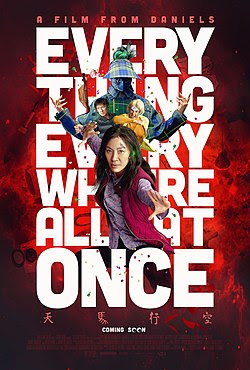
Everything Everywhere All At Once - Film Review

Woah! What is this film!

If there was a roller-coaster in an existential amusement park, that left you with not just the thrill of the experience, but also with enough neuro-synapses in the brain, that point to some answers to navigate our current personal and societal world-life crisis, that ride would be called #everythingeverywhereallatonce


Delivered through multi-metaphors, multi-verses, multi-madness, multi-emotions, multi-characters, multi-generations, and multi-relationships, this multi-Oscar-winning masterpiece is a fitting reflection of our complex, absurd, what-the-hell-is-going-on-in-the-world world. It’s a fitting title for the movie, because, unlike many other films, this one doesn’t choose just one or two aspects of our lives, but puts the ambition of dealing with everything everywhere all at once, issues of our times. Climate change, war, conflicts, displacements, marital ennui, feminism, parenting, inclusion, equality, migrant culture, youth isolation & loneliness, the meaning of life, generational emotional traps… did I miss anything! 


And that’s the reason the film takes this mad exaggerated mind-numbing fantastical story-telling. 

Because one has to be completely crazy to tell this story. 

Because it’s the story of our lives, right here, right now. 

Because we all know it, we all feel it, every day…. 

The mesmerizing voice of Seal, playing in my head “We’re never gonna survive unless we get a little Crazy”


The story revolves around Evelyn Quan (Oscar-winning performance by Michelle Yeoh), running a laundromat with her husband, Waymond (Ke Huy Quan), living with an ailing-but-patronizing father, Gong Gong (James Hong), and daughter Joy (Stephanie Hsu), being audited and harassed by the IRS, led by agent Dierdre (Oscar-winning performance by Jamie Lee Curtis). When a meeting at the IRS office, triggers an opening of the multi-verse, Waymond from the Alpha-verse finds Evelyn, connecting her to the multi-verse, enabling her to lead the fight against the gone-rouge daughter Jobu Topaki (aka Joy) and simultaneously against her own side led by the Alpha verse’s Gong Gong (her father). Moving between the different universes, the worlds, and the people collide, fighting the battle for hope, for redemption, and for oblivion. 


Straddling between the many many multi-verses and the many many versions and lives of Evelyn and Waymond and Joy and Diedre (including one, where Joy and Evelyn are just rocks.. literally!), we see on one side, the despair, the frustration, the futility, the irrelevance, the dystopian reality of our lives, represented by Jobu Topaki/Joy. On the other side, we see the hopeless romanticism, the naive belief in a better world, the quiet rebellion of goodness, and the inner strength of Waymond. “When I choose to see the good side of things, I’m not being naive. It is strategic and necessary. It’s how I’ve learned to survive through everything.” And caught between, we see the desperate stuck-ness, the chaos, the loneliness, the helplessness, the nothingness, the regrets, the quiet resentment of choices of the past that continue to define the present, the anger at a male-dominated and un-inclusive world that we don’t even notice anymore, shown through Evelyn.


Through the eyes of Evelyn, we see the world as it is, but as the story evolves through its mad narrative, we also begin to see the world as it could be. And the narrative surprisingly moves us from despair to hope. The turning point comes from the most unexpected place and when we least expect it. In the middle of what seems to be the end of it all, Waymond cries out loud “The only thing I do know is that we have to be kind. Please. Be kind, especially when we don’t know what’s going on”. The impact of this is instantly felt, in the film, but also by the viewer. We ask ourselves, could the answer really be as simple as that? This, then, finally sets the tone for what follows in the film, towards a final conclusion.


A powerful film, delivered by powerful performances.

A tome of our times.

An Insanity

A Catharsis.

A Humanity.

#EverythingEverywhereAllAtOnce


Even though Jobu Topaki tries to convince us that “Nothing Matters”, because in the end, we’re all dead.

In our hearts, we know that “Everything Matters”, precisely because in the end, we’re all dead.


The question is, do they make it in end, in the film? 

And also, Will we make it, in our world and in our lives?

I go back to what Waymond says in the film
“Most people only have a few significant alternate life paths so close to them. But you, here, you’re capable of anything because you’re so bad at everything”.